Article
Jun 22, 2026
Meta vs Google: which one is actually driving your Shopify revenue?
Most D2C founders run both Meta and Google. Both dashboards show conversions. Both claim credit for the same sale. Here's whose numbers you should actually believe and how to find your true marketing ROI
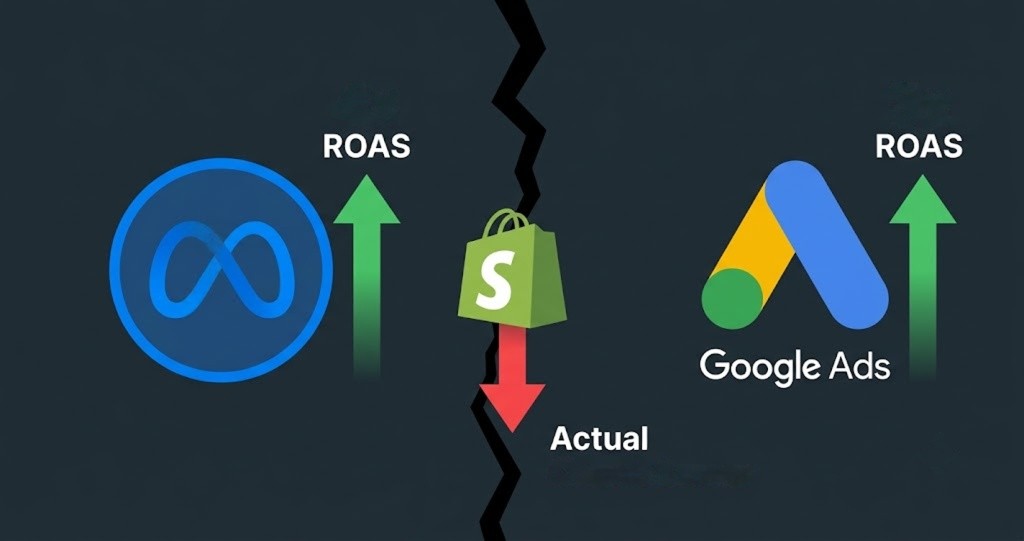
Most D2C founders run both. Most trust neither completely. And almost none have a clean answer to which one is actually working.
This isn't a platform comparison. It's a question about whose numbers you should believe when both are claiming credit for the same sale.
The setup every D2C brand knows
You're running Meta for awareness and retargeting. You're running Google for branded search and Shopping. Both dashboards show conversions. Both show positive ROAS. You open Shopify and the revenue number sits somewhere between the two, lower than what either platform claims, sometimes lower than both combined.
You've been here before. You allocate more to whichever platform had a better week. The cycle repeats.
The problem isn't your campaigns. It's that you're making allocation decisions based on two platforms that are each measuring their own influence, not yours.
How Meta counts a conversion
Many Meta accounts use 7-day click and 1-day view reporting, though advertisers can customize these windows.
Someone clicks your Meta ad on Monday. Doesn't buy. Opens a bookmark on Sunday and completes the order. Meta counts it as their conversion because the click was within the 7-day window.
Someone scrolls past your Meta ad on Tuesday. Doesn't click. That evening they see an influencer post the same product, tap the affiliate link, and buy. Meta fires a conversion because the impression was within the 24-hour view window. The influencer wants their cut. Two parties. One customer. One order. Both claiming credit.
Meta isn't lying exactly. It's measuring something, just not what you think. The platform's job is to show you that Meta is working. It's quite good at that.
How Google counts a conversion
Google attribution varies by campaign type and attribution model. Search campaigns typically use last-click attribution within a 30-day window, but Performance Max, YouTube, and Display introduce their own attribution challenges.
Someone clicks your Google Shopping ad. Browses. Leaves. Three weeks later they see your Meta retargeting ad, click it, and buy. Google counts it as their conversion because the Shopping click was within 30 days. Meta counts it too because the retargeting click was within 7 days. Shopify records one order.
Search campaigns generally over-report less than social because they require explicit user intent. Someone typing your brand name or product category is already closer to buying. But that doesn't mean Google's numbers are accurate. They're just wrong in a different direction, and PMax makes it harder to see where credit is actually going.
One order. Three platforms. Three claimed conversions
This is how one Rs 3,000 order actually looks across your dashboards:
Platform | Revenue Claimed | Attribution Logic | Reality |
|---|---|---|---|
Meta Ads | Rs 3,000 | 1-day view, customer scrolled past a Reel | May have influenced awareness but can't prove it caused the purchase |
Google Ads | Rs 3,000 | Last-click, customer typed your brand name | Captured high purchase intent but may not have created it |
Klaviyo | Rs 3,000 | 5-day email open window | Delivered the final touchpoint, not necessarily the original demand |
Shopify | Rs 3,000 | Actual bank account | One package ships |
Three platforms. Rs 9,000 of reported revenue. One order. One customer.
This isn't fraud. Every platform is telling the truth about what it saw. They just can't see what they didn't touch. No platform sees the whole customer journey.
Which one over-reports more?
From what we see across D2C brands running both simultaneously, Meta over-reports more aggressively, more consistently.
Two reasons.
View-through attribution. Meta counts impressions as conversions if a purchase happens within 24 hours. Search campaigns don't have a view-through window. Someone has to actually click. This alone inflates Meta's numbers significantly for brands running high-volume awareness or Reels campaigns.
The nature of the audience. Meta reaches people who weren't looking for your product. Search reaches people who were already looking. The Search customer was closer to buying before the ad appeared.
Neither is the full picture. But as a signal of incremental impact, Search ROAS is typically closer to reality than Meta ROAS for most D2C categories.
The incrementality problem nobody talks about
Both platforms suffer from a deeper issue: low incrementality.
Incrementality asks a harder question than ROAS. Did this ad actually cause a sale that wouldn't have happened anyway?
Meta's view-through conversions frequently claim credit for customers who were already planning to buy. Someone received your weekly email newsletter, opened it, then happened to scroll past your Instagram ad before checking out. Meta fires the conversion. The email caused the sale.
Branded Search has the same problem. For many established brands, a significant share of branded search traffic would likely have reached the site organically even without paid ads, though the percentage varies by category and competitive landscape. You may be paying for clicks you would have gotten for free.
This doesn't mean you should stop running either platform. It means the ROAS number each platform reports tells you how good they are at claiming credit, not how much incremental revenue they're actually generating.
What accurate allocation actually requires
You can't solve this by switching platforms or changing attribution windows. The problem is structural.
The most useful single metric for D2C brands running paid advertising across multiple channels is MER, Marketing Efficiency Ratio, sometimes called Blended ROAS:
Total Shopify Revenue divided by Total Ad Spend across Meta, Google, and all paid channels.
MER intentionally doesn't try to assign credit to individual channels. It answers a different question: for every Rs 1 spent on marketing, how much total revenue did the business generate?
Unlike platform-reported ROAS, MER includes all your revenue in the numerator, organic, direct, email, because Meta and Google top-of-funnel activity actively lifts those channels too. A customer who saw your Meta ad, didn't click, got your email three days later, and converted through the email link, that sale shows up in Klaviyo's dashboard, not Meta's. But Meta's awareness spend contributed to it.
MER gives you one honest number for the health of your overall paid strategy. When MER goes up, your advertising is working. When it drops, something is wrong, regardless of what the individual platform dashboards show.
Where possible, run controlled holdout tests by reducing spend in one channel while keeping other variables stable. If MER holds steady, that channel wasn't driving incremental sales. If it drops, you have your answer. That's incrementality testing, and it's the most reliable way to know which platform is actually earning its budget.
The question worth asking
If Meta says 4x ROAS and Google says 3x ROAS and your MER is 2.2x, which platform do you cut budget from?
The answer isn't in either dashboard. It's in understanding which touchpoints your customers actually needed before they bought, and which ones were just along for the ride.
Every advertising platform measures its own success. Your business only measures one thing: money in the bank. The gap between those two is where most budget mistakes happen.
QuickInsights.ai brings Shopify, Meta, and Google into one dashboard so you can track blended MER over time and make budget decisions using business performance, not platform-reported credit. Book a free demo.